
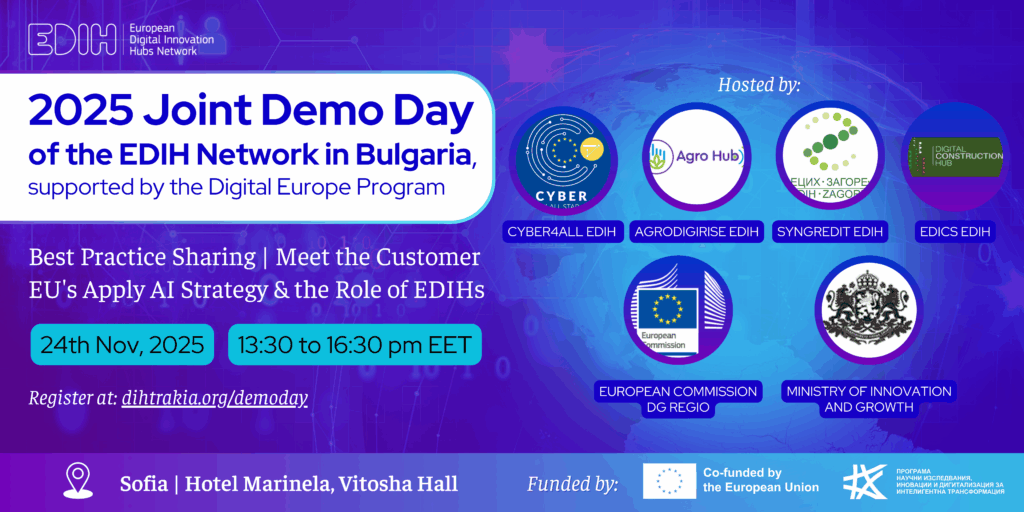
On November 24, 2025, the Bulgarian Network of European Digital Innovation Hubs (EDIHs) gather together in Sofia for a Joint Demonstration Day, hosted as part of the European Digital Open Innovation Days by Cyber4AllSTAR EDIH, with support from the Digital Europe Programme, DG REGIO, the Ministry of Innovation and Growth, AgroDigiRise EDIH, EDICS EDIH, and SynGReDiT EDIH.
The event took take place at Hotel Marinela, bringing together innovation leaders, SMEs, public sector representatives, technology providers, and experts working to accelerate the green and digital transformation across Bulgarian regions.
The afternoon began at 13:30 with registration and refreshments, during which participants arrived and engaged in informal exchanges. This initial phase created an atmosphere of openness and collaboration, reflecting the event’s core philosophy of shared learning within a networked ecosystem. Representatives of different EDIHs, SMEs, and institutions used the opportunity to reconnect, exchange experiences, and prepare for the structured programme that followed. From the outset, the presence of multiple hubs and stakeholders highlighted the maturity of the Bulgarian EDIH network and its role as a connector between European policy priorities and local implementation.
Accelerating Digital Transformation Across Bulgaria’s Regions
The opening segment highlighted the role of EDIHs in supporting businesses and public organisations to adopt digital technologies and enhance competitiveness. Representatives from DG REGIO and the Ministry of Innovation and Growth addressed ongoing progress and future directions for regional innovation policy.
Sharing Best Practices from the National EDIH Network
The first panel discussion, “Sharing is Caring: Supporting Clients’ Digital Transformation Throughout the 2023–2025 Period,”. This panel brought together leading representatives from across the Bulgarian EDIH network and was dedicated to sharing lessons learned, challenges encountered, and successful approaches developed during the current programming period:
- Svetlana Boyanova, AgroDigiRise EDIH (AgroHub.BG)
- Dr. Hristian Daskalov, Cyber4AllSTAR EDIH (EDIH Trakia)
- Maria Nakova, EDICS EDIH (EDIH in construction sector)
- Dr. Rumyana Grozeva, SynGReDiT EDIH (EDIH Zagore)
This session focused on practical lessons learned in supporting SMEs and public sector organisations through “test before invest” services, skills development programmes, and digital transformation strategy support.
Svetlana Boyanova from AgroDigiRise EDIH, operating as AgroHub.BG, opened the discussion by highlighting the specific needs of the agricultural sector. She explained that digital transformation in agriculture requires tailored solutions that respect sectoral realities, stating that EDIHs must “speak the language of farmers and agri-businesses while opening the door to advanced digital tools and data-driven decision-making.”
The formal programme commenced at 14:00 with opening remarks delivered by representatives of DG REGIO and the Ministry of Innovation and Growth. Their joint address focused on the theme of “the twin green and digital transformation of regional economies.” In their statements, the speakers emphasized that digitalisation and sustainability are not parallel agendas but interconnected processes that must be addressed simultaneously. They underlined that European Digital Innovation Hubs are central instruments in translating cohesion policy, innovation policy, and the objectives of the Digital Europe Programme into practical support for businesses and public organisations at regional level. The representatives stressed that EDIHs provide not only access to technologies but also strategic guidance, skills development, and trust, all of which are essential for long-term competitiveness and resilience.
Dr. Hristian Daskalov, representing Cyber4AllSTAR EDIH and EDIH Trakia, continued the panel by focusing on cybersecurity and horizontal digital transformation services. He emphasized that many SMEs and public organisations approach digitalisation with ambition but limited awareness of cyber risks. According to Dr. Daskalov, “digital transformation without cybersecurity is inherently unstable,” and he underlined the importance of integrated services such as test-before-invest, cybersecurity assessments, compliance support, and targeted training. He reflected on the 2023–2025 period as one in which EDIHs have increasingly moved from awareness-raising to hands-on implementation support.
Maria Nakova from EDICS EDIH, representing the construction-focused digital innovation hub, brought an industry-specific perspective to the discussion. She described how digitalisation in construction often faces resistance due to traditional workflows and fragmented value chains. Nakova noted that the EDIH model helps overcome these barriers by providing neutral, trusted environments where companies can experiment with digital tools and new processes before committing resources. She stressed that “the value of EDIHs lies in reducing uncertainty for SMEs and helping them make informed decisions.”
Dr. Rumyana Grozeva from SynGReDiT EDIH, also known as EDIH Zagore, concluded the panel by highlighting regional innovation dynamics and the importance of proximity. She explained that trust-building and long-term engagement are particularly important outside major urban centres. Dr. Grozeva stated that EDIHs serve as anchors in regional ecosystems, ensuring that digital transformation opportunities reach SMEs and public organisations regardless of location. The panel as a whole demonstrated the diversity of sectoral approaches within the Bulgarian EDIH network, while also revealing a shared methodology centered on client-centric services and collaboration.
At 14:50, the programme moved into a fireside chat titled “Meet the Customer: Best Practices and Ideas for Improvement in EDIHs’ Customer Journeys.” This session featured representatives from the customer base of different EDIHs and provided a platform for direct feedback from beneficiaries. Through moderated discussion, customers shared their experiences of working with EDIHs, highlighting strengths such as accessibility, practical relevance, and the ability to navigate complex funding and technology landscapes. They also offered constructive suggestions for improvement, emphasizing the need for clearer communication of services, smoother onboarding processes, and continued support beyond pilot phases. This dialogue reinforced the principle that EDIHs are service-oriented structures whose effectiveness depends on continuous learning from users.
AI Strategy: The Next Phase of Digitalisation
A keynote presentation from a representative of the AI Innovation and Policy Coordination Unit at DG CONNECT (European Commission) highlighted the connection between the Apply AI Strategy and the work of EDIHs, particularly regarding AI readiness for SMEs and public sector institutions.
The keynote, delivered by a representative of the Artificial Intelligence Innovation and Policy Coordination Unit at the Directorate-General for Communications Networks, Content and Technology of the European Commission, addressed “The Apply AI Strategy and the EDIH Network: The Role of EDIHs in the EU’s Overarching Artificial Intelligence Sectoral Strategy.” The speaker outlined the objectives of the Apply AI Strategy, emphasizing the need to move from experimentation to large-scale adoption of AI solutions across sectors. In this context, EDIHs were presented as critical enablers of AI readiness, particularly for SMEs and public administrations that lack internal expertise. The keynote highlighted that EDIHs can support trustworthy AI adoption by combining technical support with guidance on ethics, regulation, and skills development, ensuring alignment with European values.
The second panel, “Exploring What’s Next: EDIHs Value Proposition in Support of the Apply AI Strategy,” brought AI experts from across the national and European networks to outline shared capabilities and future opportunities for cross-regional collaboration.
The discussion focused on future-oriented services, cross-regional collaboration, and the scaling of AI solutions. Panelists explored how EDIHs can jointly develop competencies, share infrastructure, and coordinate efforts to support SMEs in adopting AI for productivity, sustainability, and competitiveness. The speakers emphasized that the next phase of digital transformation will require deeper integration of AI into business processes, and that EDIHs must evolve accordingly by strengthening their expertise and partnerships.
Throughout the panel, the importance of cooperation within the EDIH network was repeatedly highlighted. Speakers noted that no single hub can cover all technological domains or sectoral needs, but that the network as a whole can offer comprehensive support through collaboration. This perspective aligned closely with the event’s overarching message that shared knowledge and coordinated action are key to maximizing impact at national and European level.
The formal programme concluded at 16:20 with a networking and refreshments session that continued until 17:00. This final segment provided space for informal discussions, follow-up conversations, and the exploration of potential partnerships. Participants from different hubs, institutions, and companies used the opportunity to exchange contact details, discuss joint initiatives, and reflect on the insights gained during the event. The networking session reinforced the sense of community within the Bulgarian EDIH network and underscored the importance of face-to-face interaction in building trust and collaboration.
In conclusion, the Joint Demonstration Day of the Network of European Digital Innovation Hubs in Bulgaria on 24 November 2025 successfully showcased the collective capacity of the EDIH ecosystem to support digital and green transformation. Through a carefully structured chronological programme, the event combined strategic policy perspectives, practical experience sharing, customer feedback, and forward-looking discussion on artificial intelligence. By bringing together representatives from DG REGIO, national authorities, multiple EDIHs, SMEs, and AI experts, the event demonstrated how European and national initiatives converge at the level of practical implementation. It reaffirmed the role of EDIHs as key instruments for translating European digital strategies into tangible benefits for regional economies, while also highlighting the importance of continued collaboration, learning, and innovation within the network.