
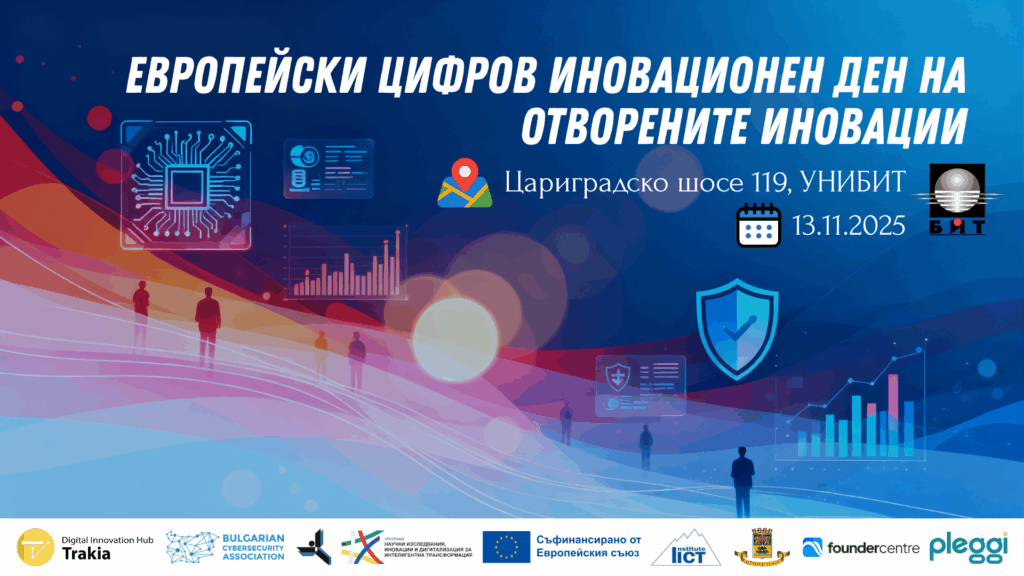
The European Digital Innovation Day for Open Innovation, a series of events comprising two modules (Investor Day, Hybrid Webinar), held on November 13, 2025, at UniBIT, brought together universities, innovation hubs, startups, investors, and public institutions to accelerate the transformation of knowledge into market-ready products and secure, scalable businesses. Organized by the European Digital Innovation Hub “Trakia” in collaboration with UniBIT, FounderCentre, and Pleggi Ltd., and held as part of the “Cyber4AllSTAR” project, the event was aimed at startups, students, researchers, and stakeholders from the ecosystem with a single goal: to connect education, research, funding, and cybersecurity into a practical innovation process.
Purpose and Format
The events were designed as an interactive, multi-format platform rather than a series of lectures. Participants engaged directly through panel discussions, workshops, consultations, hands-on demonstrations, and an exhibition (Startup Expo). The main themes were cybersecurity, digitalization, and access to European and private funding—with concrete, practical support for startup readiness, compliance, and investment readiness. Practical elements included a 10-day hackathon for students and entrepreneurs (“Innovation from Knowledge”), free cyber risk assessments, investor panels, and booths offering grant consultations.
Key participants and opening remarks
The official opening outlined the priorities for the day: Professor Tereza Trencheva (Vice Rector, UniBIT) emphasized that knowledge only gains value when it is put into action; Dr. Hristian Daskalov (Chair, EDIHTrakia) emphasized that cybersecurity must be integrated into innovation from the very beginning; while Stefan Grigorov (FounderCentre) and Tsvetelin Nikolov (Pleggi) urged founders to view entrepreneurship as a process of continuous learning and networking. Representatives from the Bulgarian Investment Agency, the Fund of Funds, and the Ministry of Education highlighted the national and European mechanisms that support technology-oriented enterprises.
Funding and Investor Commitment
The investor-focused sessions were a key pillar. Panels such as “2026 is approaching: Europe’s billions—where will the money flow?” and “There’s Money, But for Whom? Foreign Investment and European Funds” explored how startups can align their projects with EU funding priorities, improve their financial literacy, and attract external capital. Panelists from the Fund of Funds, the Bulgarian Investment Agency, venture capital funds, and banks emphasized that access to significant public and private capital of the type ” ” requires preparation, realistic business models, and partnerships within the ecosystem. Practical consultations at the EDIH booth offered personalized guidance on available EU instruments and avenues for private financing.
Cybersecurity as a core factor (rather than an afterthought)
A key feature of the day was the integration of cybersecurity into every relevant topic. The sessions and live demonstrations covered cyber risk scenarios, risk mitigation strategies, and support for compliance with requirements related to EU initiatives (including the Open Source Cyber Resilience Act and related projects). Cyber4AllSTAR and partner projects provided free readiness assessments and advice on penetration testing, while B2B/B2C roundtables explored the effects of digital transformation on sectoral resilience. Organizers and experts stated that “innovation without cybersecurity is unstable,” urging startups to implement security practices early on to protect investors, customers, and growth.
Education, Entrepreneurship, and the “Triple Helix”
The program deliberately linked academic talent with market needs. Panels and working groups explored how to turn student projects and university research into viable startups, with the founders’ personal stories highlighting common paths and pitfalls. The panel “Science, Business, Money: Can We Connect Them?” focused on technology transfer and practical models for collaboration between universities, industry, and government—the so-called “triple helix.” The inclusion of a university hackathon and awards highlighted hands-on learning and early team validation as pathways to commercialization.
Practical support and results
Throughout the day, participants had access to:
- One-on-one consultations on grant funding, EU project opportunities, and investment readiness.
- Free cyber risk assessments, compliance guidance, and penetration tests.
- Seminars and master classes led by experienced entrepreneurs, investors, and academics.
- Demonstrations of attack scenarios and risk management techniques to improve preparedness.
- The Startup Expo, where 39 Bulgarian startups showcased their products and services (the organizers reported that over 80% of them already have customers and are valued at over €1 million).
These practical proposals were designed to alleviate the challenges faced by startups seeking funding, customers, and technical stability.
Scale and Impact
The events attracted over 500 participants, including students, academics, entrepreneurs, investors, public institutions, and the media. It combined structured panels with open spaces for consultations to ensure that participants would leave with new knowledge and concrete next steps (applications, partnerships, or follow-up consultation meetings). The day concluded with awards for the hackathon teams and the publication of a White Paper on Knowledge and Action, summarizing the forum’s recommendations for improving the regional innovation ecosystem.
Why this is important for companies and founders
European Digital Innovation Day demonstrated a replicable model: embedding cybersecurity and funding readiness into early-stage innovation, while connecting university talent with industry mentors and investors. For startups, the events offered direct practical benefits—tailored funding advice, security audits, and connections to investors and networks that shorten time-to-market. For institutions and policymakers, it provided evidence that coordinated interventions involving multiple stakeholders (ECIX services, university programs, targeted funding advice) can increase the chances of research and student projects becoming sustainable businesses.
Conclusion
The events at UniBIT demonstrated that successful innovation ecosystems require three elements working in tandem: rigorous technical and security practices, realistic financial and business models, and continuous collaboration between academia, industry, and public stakeholders. By combining active formats (hackathon, consultations, exhibition) with focused panels and practical cybersecurity support, the event turned ideas into concrete next steps for entrepreneurs and created a clear roadmap for regional innovation development.
Събитията са по проект № 101083793 – CYBER4All STAR – DIGITAL-2021-EDIH-01 на Европейската комисия и проект № BG16RFPR002-1.001-0003 по програма „Изследвания, иновации и дигитализация за интелигентна трансформация“. Изразените възгледи и мнения са само на автора(ите) и не отразяват непременно възгледите и мненията на Европейския съюз. Нито Европейският съюз, нито предоставящият орган са отговорни за тях.